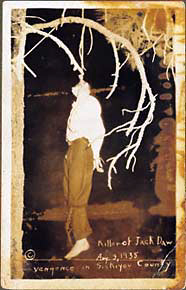
Documented historical photograph
Clyde Johnson
The body of Clyde Johnson following his lynching in Yreka, California. The photograph survives as part of the historical record documenting racial terror in the western United States.
Historical Archive
Between the late nineteenth century and the mid-twentieth century, thousands of African Americans were murdered in acts of racial terror. Many of these killings were carried out before crowds and recorded by photographers. Some photographs were printed as postcards, exchanged, collected, and mailed through the United States postal system.
The images preserved here are not presented as spectacle. They are historical evidence. They testify to lives taken, communities terrorized, and a history that remains unfinished.
This page contains graphic historical photographs documenting lynching and racial terror in the United States. These images are presented as evidence, not as spectacle.
Some victims have been identified through historical records. Many have not. Their names were never recorded, were lost, or remain under investigation. Viewer discretion is advised.
Archive Methodology
This archive was assembled through comparison with published historical collections, visible inscriptions, contemporary newspaper records, memorial archives, museum records, and other documentary sources. When a photograph can be tied to a documented historical event, the victim, location, and date are identified. When the evidence remains incomplete, the image is presented without forcing it into a name.
The goal is not certainty where certainty does not exist. Many lynching victims were poorly documented, misidentified, or forgotten altogether. In some cases the photograph survived while the person’s name did not. This archive preserves both what is known and what remains unresolved.
Documented Historical Photographs
These photographs are presented with names, locations, and dates where the available evidence supports them. Where the image is historically documented but the victim’s name is not known, the caption says so plainly.
Documented historical photograph
The body of Clyde Johnson following his lynching in Yreka, California. The photograph survives as part of the historical record documenting racial terror in the western United States.
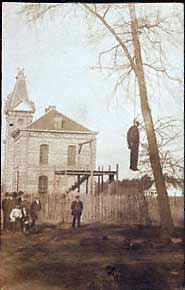
Documented historical photograph
This historical photograph depicts an unidentified African American man following a lynching. Although the victim’s name, exact location, and date have not been conclusively established, the image survives as part of the historical record documenting racial terror in the United States.
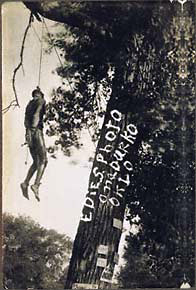
Documented historical photograph
Bennie Simmons is shown alive and bound before being burned by a mob in Anadarko, Oklahoma. The photograph records the public nature of the violence and the use of photography to preserve the spectacle of racial terror.
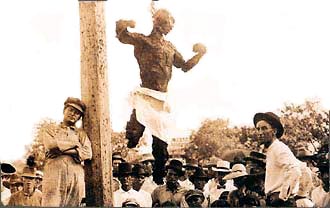
Documented historical photograph
Burnt corpse of William Stanley following his lynching in Temple, Texas. The photograph records the public display of his body after the killing and survives as part of the historical record of racial terror in the United States.
The photograph was circulated as a postcard, making the image not only a record of violence but also evidence of how lynching could be turned into a social object and souvenir.
Historical artifact
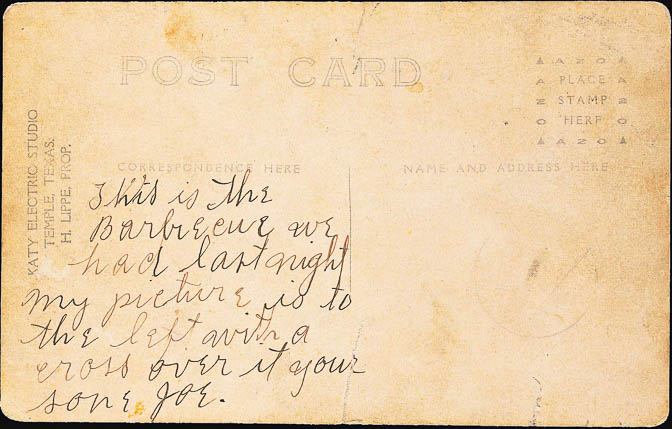
Reverse side of the postcard associated with the William Stanley lynching photograph.
“This is the barbecue we had last night. My picture is to the left with a cross over it. Your son, Joe.”
The handwritten message demonstrates how lynching photographs were circulated through the mail and treated as souvenirs by participants and spectators. The writer appears to identify himself among the crowd present at the killing.
Documented historical photograph
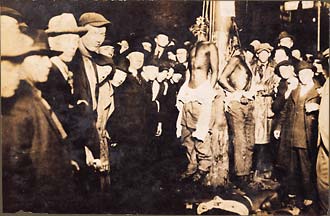
The bodies of Elias Clayton, Elmer Jackson, and Isaac McGhie following their lynching in Duluth, Minnesota. Their murders demonstrate that racial terror was not confined to the American South.
Related historical photograph
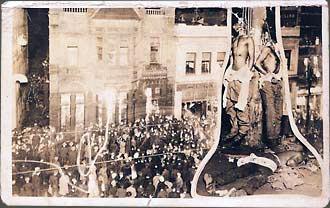
This composite or alternate postcard image is connected to the Duluth lynching of Elias Clayton, Elmer Jackson, and Isaac McGhie. It is retained here as related visual evidence of the same event and of the reproduction of lynching images as public objects.
Documented historical photograph
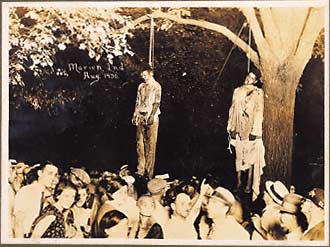
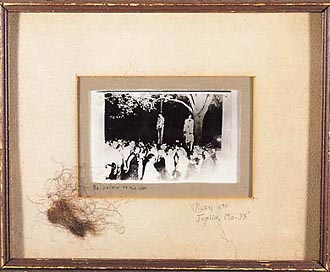
The bodies of Thomas Shipp and Abram Smith after their lynching in Marion, Indiana. This widely reproduced image is one of the most recognizable photographs in the history of American racial terror.
Related historical photograph
An alternate framed or copied version of the Marion photograph. Its presence in the archive shows how lynching images could be reproduced, preserved, and recirculated long after the event itself.
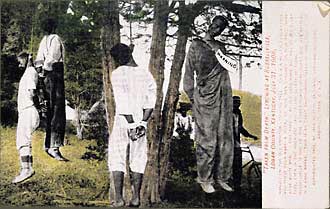
Documented historical photograph
This historical photograph documents four victims lynched in Inverness, Florida: Jerry Williams, George Davis, Willie Williams, and Albert Robertson. The image and its related text side preserve evidence of a multiple-victim lynching whose memory depends on surviving archival fragments.
The photograph is included as part of the historical record of racial terror in the United States and should not be confused with the separate William Stanley postcard from Temple, Texas.
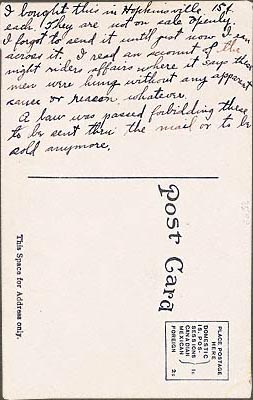
Historical artifact
Related text side associated with the Inverness image. It is included to preserve the object as an artifact, not only as a photograph. The text helps connect the image to the lynching of Jerry Williams, George Davis, Willie Williams, and Albert Robertson.
Lynching Postcards
Lynching photographs were not only records of violence. Some were printed as real-photo postcards, sold, exchanged, collected, and mailed. Their circulation turned acts of murder into social objects: evidence, warning, trophy, and souvenir at once.
The William Stanley postcard is one of the most disturbing examples in this archive because the reverse side, reproduced above, preserves the sender’s voice. The message — “This is the barbecue we had last night” — reveals how a killing could be described in the language of a communal gathering. The note does not merely document the lynching. It documents the culture that made the lynching public, sharable, and commemorative.
Names Lost, Missing, or Not Yet Verified
The photographs below remain part of the archive because they are historical evidence. They are not assigned names, dates, or locations until the evidence supports doing so.
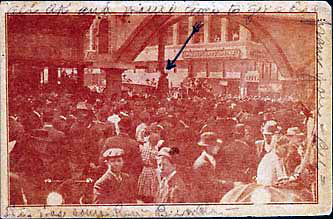
Historical photograph
This image appears to show a crowd scene with handwritten markings. It remains in the archive as historical evidence, but it should not be tied to a named event until the victim, location, and date can be supported by reliable documentation.
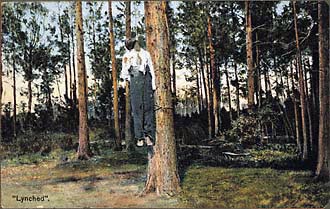
Historical photograph
The photograph shows a single victim in a wooded or rural setting. The victim, date, and location have not yet been confirmed through reliable documentation.
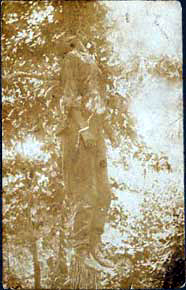
Historical photograph
A lone victim hangs from a tree. Earlier attribution to Allen Brooks is not used here because the visible image does not provide sufficient support for that identification.
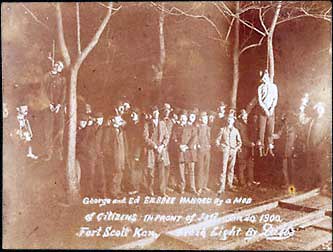
Inscription not yet verified
The visible inscription appears to identify George and Ed Baker in Fort Scott, Kansas, but the event requires independent verification before being treated as a documented case.
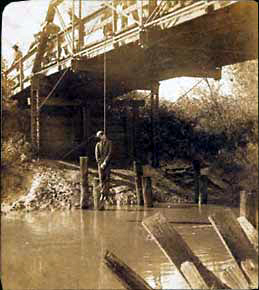
Historical photograph
A bridge or river scene with handwritten text. It is not captioned as Laura and L. D. Nelson here because the match has not been confirmed.
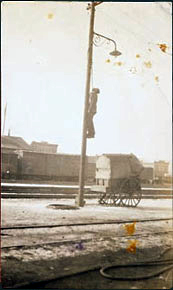
Historical photograph
The photograph appears to show a hanging near water or an industrial structure. The victim and event have not yet been identified.
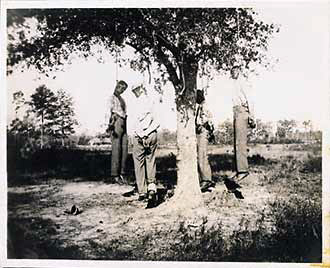
Historical photograph
This image may be an alternate or duplicate print from a documented event, but it is not captioned as William Stanley without stronger provenance.
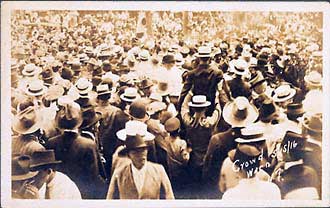
Historical photograph
A crowd scene with handwritten markings. It is not captioned as Marion unless a reliable source establishes that match.
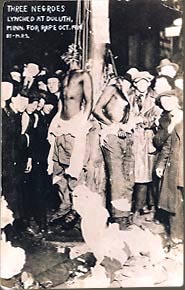
Historical photograph
The visible content appears to show more than one victim and does not support a single-victim Clyde Johnson caption. It remains unidentified pending stronger documentation.
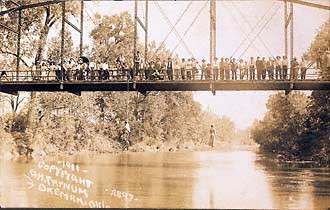
Historical photograph
This bridge scene is not automatically captioned as Laura and L. D. Nelson. The inscription and composition require verification against a reliable archival source.
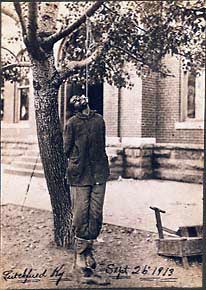
Inscription not yet verified
The visible inscription appears to provide a date, but the victim and event have not yet been verified here.
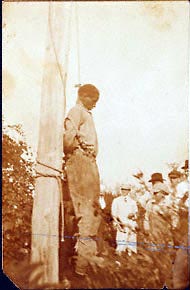
Historical photograph
A lynching photograph showing a victim and a crowd. The victim, location, and date are not yet confirmed.
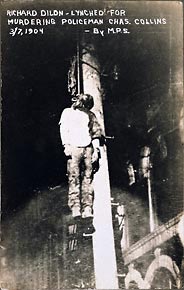
Inscription not yet verified
The visible inscription appears to identify Richard Dillon or Dillion and Memphis, but the reading requires independent verification before publication as a documented case.
Anti-Lynching History
Paul Robeson did not treat lynching as only a Southern crime or a historical shame. He understood it as a national system of terror: public violence, public humiliation, and public silence. In 1946, after the Moore’s Ford lynchings in Georgia, Robeson helped lead the American Crusade Against Lynching and pressed President Harry Truman and Congress to support federal anti-lynching legislation. Albert Einstein lent his name and moral authority to that struggle.
In The Initiation of the World, Robeson’s description of his treatment before HUAC as a “public lynching” is not presented as metaphor alone. It is placed in dialogue with the history shown here: the rope, the crowd, the spectacle, the state’s failure to protect Black life, and the long delay before the law finally named the crime.
These photographs survive because they were once circulated openly — as postcards, newspaper images, documentary evidence, and private mementos. To look at them now is not to repeat the spectacle, but to confront what the spectacle tried to normalize.
Where a name, location, or date has not been verified, this page says so plainly. The uncertainty is intentional. Memory requires courage, but it also requires restraint.
Identifications and historical context were compiled from museum collections, historical archives, scholarly publications, newspaper records, and contemporary research on racial terror and lynching photography, including Without Sanctuary: Lynching Photography in America, the Equal Justice Initiative, the Library of Congress, and other archival sources.